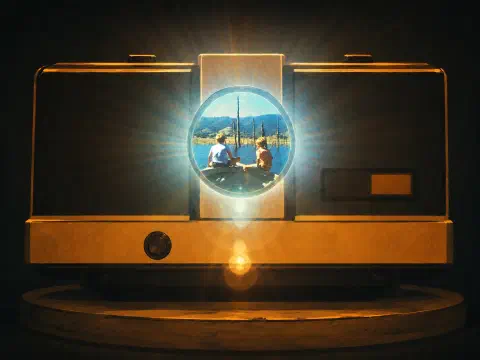
There is a scene in Mad Men where Don Draper pitches Kodak’s circular slide projector, “The Carousel”. He barely talks about the technology. Instead, he talks about what it allows people to feel, the ability to travel backwards and return to a place and a time where they still ache to be.
When my dad passed away, I found myself going through thousands of slides from my grandfather’s collection. Many showed my dad growing up with his family. I saw the father I knew as a child, a brother, and a son, living through years that had previously existed for me only as stories.
Each photograph was contained in a small square of mounted film. Held in your hand, it could be difficult to make out. Pass a light through it, though, and for that moment an entire memory returned.
Going through those slides made me think not only about what photographs preserve, but about how they used to be shared. Someone chose them, arranged them, and loaded them into a tray. People gathered in the same room. The lights went down. The projector clicked, the next image appeared, and, for a little while, a memory held everyone’s attention at once… usually accompanied by an overly confident uncle volunteering all the embarrassing stories.
The slideshow turned displaying pictures into a shared moment. I was never quite sure why, but I kept thinking about it. Eventually, I built my own Carousel.
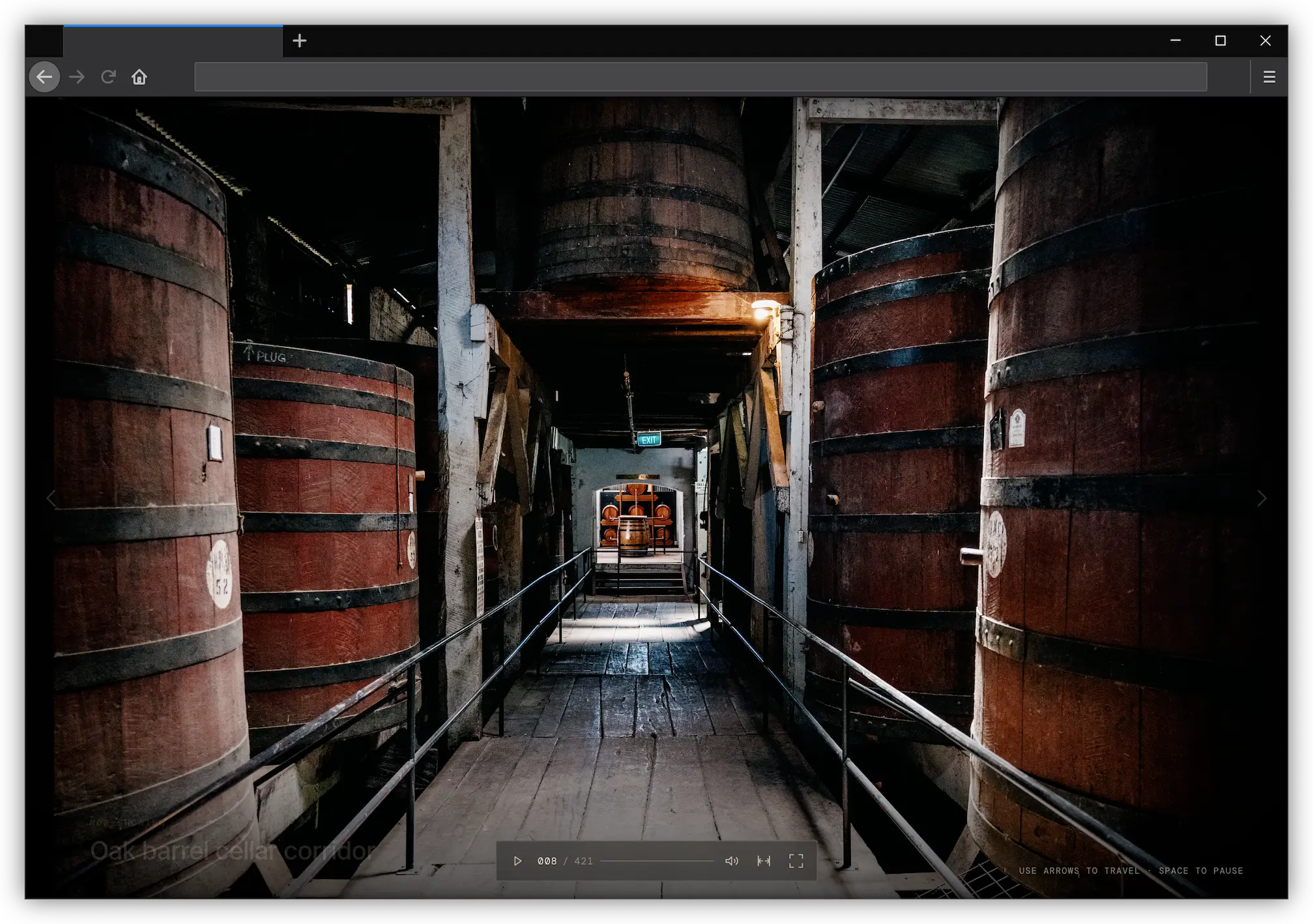 My little Flickr Carousel in use.
Before photographs became content
Photographs were once treasured objects through which memories were shared. For most of my childhood, my mum kept an emergency bag by the door in case of fire. It held no important documents or valuables, only the photographs that meant something to her.
In sharing these treasures a family might send a few prints to relatives, assemble an album, or invite people over to look through slides. The audience was smaller and the process slower, but the act of sharing was deliberate. People talked over the images. Someone explained who was standing at the edge of the frame. A photograph usually arrived with a story attached. Only the best made it into the annual Christmas card.
Social media removed almost all of the friction from that process. I can take a photograph and show it to hundreds of people within seconds.
That convenience is extraordinary, but it has also changed the photograph itself. Online, a picture becomes one more item in a feed: briefly visible between everything that came before it and whatever the almighty algorithm has decided should come next.
The interface asks us to react, like, swipe and continue. It rarely asks us simply to pause and look. Modern album tools may allow a caption, but they rarely make description or context central. It is just another set of pixels.
Worse still, sharing photographs online presents an uncomfortable choice. I can send them privately to a few friends, or upload them to a large social platform. Either way, they often disappear from meaningful view while remaining available to the companies and systems that host, index, and analyse them.
That access may arise through my own account, through a copy uploaded to a friend’s gallery, or even through the email or messaging service carrying the photograph between us. The precise terms vary, but these services generally receive broad permissions to store, process, reproduce, distribute, and even sell what we share.
I may retain the copyright, but I lose much of the practical agency that copyright is supposed to provide. The platform gains extensive rights to use the photograph, while the public gains no corresponding right to access, preserve, or reuse it. That is not publishing on terms I have chosen, and it is not contributing to a common good. It is private extraction disguised and sold as a personal convenience.
Why I still use Flickr
I’m often asked why I still use Flickr, most people have forgotten about it as a relic of the Yahoo days. But for me, Flickr still offers something closer to real sharing and real agency.
I can make a photograph genuinely available beyond a closed friend list. I can give it a title and description, organise it into albums, and link directly to it—to the actual image file not just a hosted page on the platform. Most importantly, I can choose the licence under which I am sharing it.
The licence tells people what they are allowed to do with the photograph. It lets me decide whether an image can be reused, adapted or redistributed, rather than leaving “sharing” to mean whatever a platform’s terms happen to permit.
A public licence also changes who benefits from that sharing. The platform may still receive permissions under its terms of service, but it is no longer the only party able to make use of the photograph. By applying the right licence, I can contribute the image to the commons allowing anyone to exercise the same rights I am otherwise implicitly signing away to a large corporation. Those rights do not remain locked inside a private agreement, they can be openly granted to the public, under terms I have chosen.
Flickr is still a commercial platform, of course. What distinguishes it is that photographs retain their titles, descriptions, licences, albums, direct links, and, most importantly, images can be publicly catalogued without an algorithm. It also has an API. That turns an archive in any other tools into something I can build with. Flickr can remain the place where I organise and describe my photographs while another application presents them in an entirely different way.
So with this in mind I built Flickr Carousel: a fullscreen slideshow that takes an album from Flickr and presents it with some of the rhythm and atmosphere of an old slide projector.
Building the Carousel
A small Cloudflare Worker requests the photographs from a Flickr album and returns them to the browser. This keeps the Flickr API key out of the client-side JavaScript and avoids maintaining a separate database. Flickr remains the source of the photographs and their metadata.
The browser then handles the presentation. It chooses an appropriate image size for the screen, preloads the next photograph and moves through the collection automatically or under the viewer’s control.
The slide projector effect is made from several restrained details:
- a short mechanical movement between frames;
- a brief shutter blackout;
- a warm flare as the next photograph appears;
- subtle grain and vignetting; and
- a recording of a real automatic slide advance.
The sound is muted by default because a website unexpectedly making projector noises is less nostalgic than it is just plain annoying.
The controls are modern even if the rhythm is old. The Carousel supports arrow keys, touch gestures, pause and resume, fullscreen mode, and a choice between fitting the entire photograph or filling the display. Titles and descriptions are available without permanently covering the image, and each photograph links back to Flickr, where its context and licence remain visible.
I also wanted the nostalgia to be more than just a visual makeover. The interface still needed to work properly as a web application, including keyboard controls and accessibility labels.
I wanted to recover the character of an old projector without recreating its limitations. The rhythm and atmosphere could remain, while keyboard controls, accessibility labels, and other modern conveniences made it easier to use.
A finite tray rather than an infinite feed
One of the things I like most about a physical slide projector is that it has a boundary.
A tray contains a finite number of slides. It begins somewhere, moves through them, and eventually returns to the start. Even if the order is shuffled, the collection itself has a shape and a finality.
An infinite feed is designed around the opposite idea. There must always be something else below the current image. Reaching the end is treated as a failure of engagement, or an unhealthy addiction, rather than a natural place to stop.
I did not want likes, recommendations, or an endless supply of adjacent advertising material. I wanted one photograph at a time, with just enough information to understand what was being shown.
In a feed, the interface is constantly suggesting what you should do next. With a projector, the interface can almost disappear. The photograph gets the screen, and you decide when it is time to move on.
The simpler thing I was trying to recover
I know the past was not actually simple. A box of family slides is itself a carefully edited record. It preserves some moments and omits others, sometimes by choice and sometimes by accident. Nostalgia has a habit of smoothing the edges of whatever it touches.
But the ritual asked something simpler of us. Load the tray. Dim the lights. Show one picture. Tell the story that belongs to it. Move to the next.
The projector did not ask anyone to like the photograph, repost it or remain engaged. It gave the image to the room and allowed the few people in that room, with shared memories and relationships, to reflect on why it mattered.
That is what I wanted my little Carousel to recover: a slower and more deliberate way of looking, without pretending that everything was better before the internet.
The source code for the project is freely available on GitHub at mitcdh/flickr-carousel. Like the photographs I share on Flickr, I hope someone else might find a use for it, adapt it into a Carousel of their own, or be inspired to make something entirely new.
For me, though, my Carousel will always bring me back to my dad and the thousands of small memories my grandfather had once captured, curated, and proudly shown.
Not an infinite feed. A rotating tray, a full room, and one photograph at a time.